

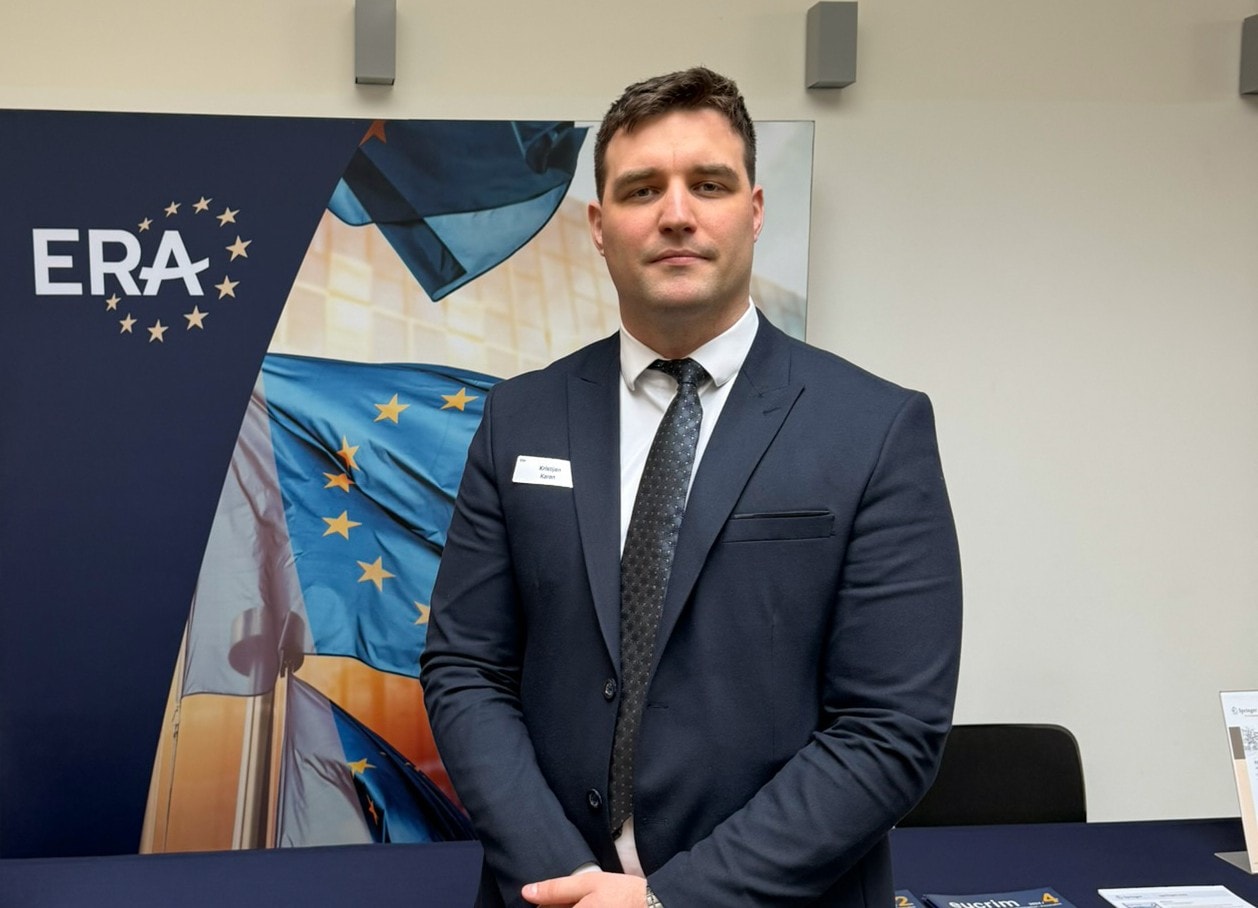
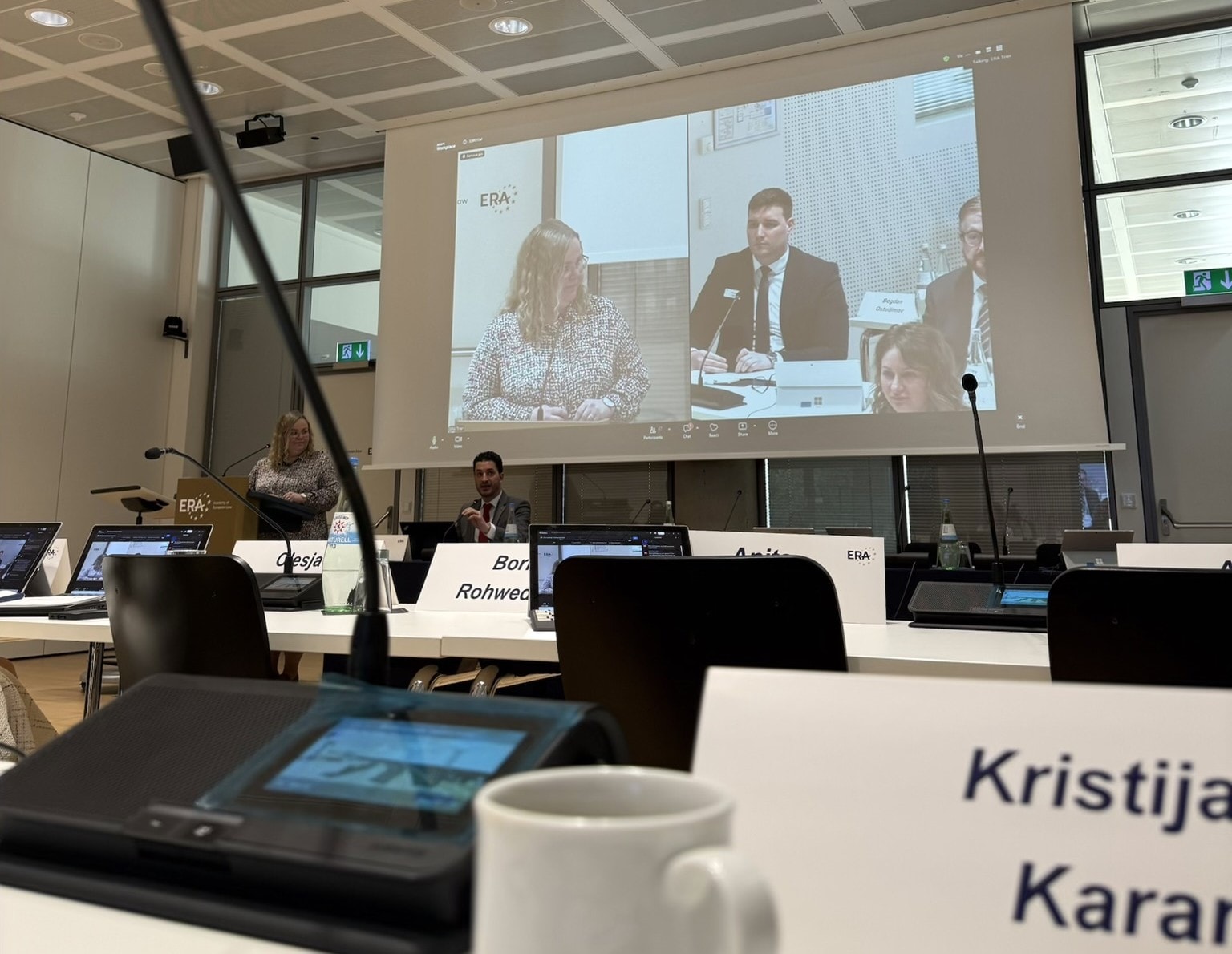
During 26 and 27 March 2026, I once again had the honour and opportunity to visit the Academy of European Law (ERA), located in Trier, Germany. The occasion for my visit was my participation in the 2026 Annual Conference on White-Collar Crime in the EU.
The conference brought together high-level legal practitioners and other senior professionals from across Europe to discuss current developments in asset recovery and confiscation, fraud and corruption, anti-money laundering, cryptoassets, the work of the EPPO, AMLA, sanctions, technology and compliance.
It provided a valuable opportunity for me to exchange experience with esteemed colleagues from across Europe, gain a deeper understanding of current trends and of the legal and practical challenges involved in cross-border asset recovery and related white-collar crime matters, and thereby further enhance the quality of legal assistance our office provides to clients from EU jurisdictions in matters connected with Serbia.
One of the most valuable aspects of the conference was its focus on issues of increasing importance in cross-border legal practice, especially asset recovery and confiscation, anti-money laundering, sanctions, regulatory compliance, and the role of key European institutions such as the EPPO, Eurojust and AMLA. In matters involving financial harm, investments, regulatory exposure and assets connected with Serbia, these topics are becoming increasingly important due to the growing need for effective cross-border coordination, a clearer understanding of European enforcement mechanisms, and the increasing relevance of EU legal and regulatory standards in practice. The discussions provided useful insight into the legal and strategic considerations relevant to asset tracing, recovery of funds, cross-border coordination and the broader European enforcement framework.
Kristijan Karan in discussion with Kristel Siitam-Nyiri, European Prosecutor at the European Public Prosecutor’s Office (EPPO), Luxembourg.
A particularly important presentation for my field of work was delivered by Ms Rita Simões, Senior Specialist for Asset Recovery at the Basel Institute on Governance, on the subject of the latest developments in asset recovery and confiscation under Directive (EU) 2024/1260. Her presentation addressed one of the key practical issues in cross-border proceedings: how to ensure effective asset recovery while safeguarding fundamental rights and securing restitution for victims. Particular attention was given to the asset recovery lifecycle itself - tracing, freezing, confiscation and disposal - with a strong emphasis on the need for early intervention, effective asset management and coordinated cross-border enforcement.
One of the most important practical points addressed in this presentation was that, in cross-border asset recovery, assets often move faster than legal procedures, with this difficulty being particularly pronounced in relation to digital assets. Attention was drawn to the gap that may arise between tracing and freezing, especially where intelligence must still be converted into admissible evidence, formal instruments must be used, or action must be coordinated across different legal systems. From the perspective of legal practice in Serbia, this is especially relevant in matters where assets connected with EU citizens, companies or proceedings may be located outside the European Union. In such cases, any delay may significantly reduce the realistic prospects of recovery, which makes early tracing, timely coordination and swift legal action particularly important.
Another particularly valuable aspect of the presentation was its emphasis on asset management as an essential component of effective asset recovery, rather than a merely technical issue following seizure. It was explained that preserving the value of assets, minimising maintenance costs and depreciation, and planning appropriate measures at an early stage are all crucial if recovery is to remain meaningful in practice. The presentation also addressed the continuing difficulties of cross-border enforcement, including parallel proceedings in different jurisdictions, conflicting freezing or confiscation orders, insufficient assets to satisfy multiple victims, and broader coordination problems between legal systems. These considerations are of clear practical significance in cases connected with Serbia, where the effectiveness of any recovery effort may depend not only on identifying assets, but also on ensuring that they are properly preserved, managed and coordinated within a wider international enforcement context.
Another highly relevant presentation was delivered by Prof. Dr. Gert Vermeulen, Senior Full Professor at Ghent University and Director of the Institute for International Research on Criminal Policy (IRCP), on the latest developments in updating the EU’s anti-fraud and anti-corruption measures. His presentation focused on three closely connected developments: the 2025 White Paper for the Anti-Fraud Architecture Review, the 2025 Rule of Law Report, and the proposed new EU Directive on combating corruption by criminal law. A central point of the presentation was that the European Union is moving towards a more coherent and better coordinated anti-fraud and anti-corruption framework, aimed not only at protecting the Union’s financial interests, but also at improving prevention and detection, strengthening investigation and prosecution capabilities, and making recovery processes more efficient through closer complementarity between institutions such as OLAF, the EPPO, Europol, Eurojust and AMLA.
Particularly valuable was the emphasis placed on the broader significance of anti-corruption measures within the European legal order. The presentation made clear that the rule of law is not only a constitutional or institutional concept, but also a foundation for legal certainty, fair competition, sound public procurement, and the protection of the single market against infiltration by organised crime. In that sense, the 2025 Rule of Law Report was presented as an important source for assessing the effectiveness of anti-fraud and anti-corruption measures, including the prevention and sanctioning of fraud and corruption and effective cooperation with OLAF and the EPPO. For legal practice involving Serbia, this perspective is especially relevant in cross-border matters connected with investments, public-sector exposure and business relationships with EU-based actors, since such matters are increasingly assessed against evolving European standards of transparency, institutional cooperation and regulatory credibility.
A further important part of the presentation concerned the proposed new EU Directive on combating corruption, which was presented as a major step towards replacing the previously scattered and incomplete EU framework with a broader and more modern legislative instrument. Particular attention was given to the expansion of the material scope of corruption-related offences, including active and passive bribery in both the public and private sectors, misappropriation, trading in influence, obstruction of justice, enrichment and concealment, as well as to the liability of legal persons, stronger penalties and investigative tools, freezing and confiscation, whistleblower protection and cooperation between Member States and Union bodies. For practitioners dealing with cross-border matters, these developments are significant because they reflect a clear tendency towards more structured, demanding and enforceable anti-corruption standards, which are increasingly relevant not only within the EU itself, but also in matters involving third countries where assets, transactions, companies or legal risks may be linked to EU jurisdictions.
Another highly relevant presentation was delivered by Mr Clifton Grech, Manager, Intelligence Analysis Section at the Financial Intelligence Analysis Unit (FIAU) of Malta, on the challenges and practical insights involved in investigating illicit financial flows from an FIU perspective. A central point of his presentation was that white-collar crimes are frequently concealed through complex legal structures and financial transactions spanning multiple jurisdictions, which means that no single FIU, law enforcement authority or other institution acting alone can comprehensively address them. In that context, particular emphasis was placed on international cooperation, FIU-to-FIU exchange of information, cross-border reporting and dissemination, and the increasing role of joint analyses supported at European level, including through AMLA.
From left to right: Mr Kristaps Bresis (Judge in Latvia), Mr Boris Rohwedder (Director, Anti-Financial Crime & Forensics at PwC Luxembourg) and Mr Kristijan Karan.
What made this presentation especially valuable from a practical perspective was its clear emphasis on access to information and institutional coordination. The presentation showed that effective financial intelligence analysis depends on timely access to a broad range of data sources, including bank account registers, property and asset registers, fiscal data and other administrative databases, as well as on cooperation with supervisors, regulators and reporting entities. In that context, those interested in this topic may also refer to my article onbeneficial ownership transparency in Serbia.Particular attention was also given to the role of so-called professional enablers, including lawyers, accountants and financial institutions, and to the importance of regulatory cooperation in identifying professional money-laundering facilitators, compromised financial institutions and virtual asset-based networks. For legal practice involving Serbia, these points are especially relevant in matters where assets, companies, beneficial ownership structures or financial flows connected with EU jurisdictions may extend beyond the Union itself and require effective coordination between different authorities and information systems.
The presentation also offered useful insight into tax-related and sanctions-related crimes as predicate offences for money laundering. In relation to tax matters, the speaker referred to serious or complex tax evasion, layering of foreign proceeds of criminal tax evasion and VAT fraud, while in relation to sanctions he distinguished between sanctions violations and sanctions circumvention, both of which may generate proceeds of crime and therefore become relevant from an AML perspective. Particularly noteworthy was the attention given to typologies such as the abuse of legal persons for concealment or circumvention, the use of jurisdictions not implementing EU sanctions regimes, abuse of the maritime industry, and the use of strawmen. From the perspective of Serbia, these observations are of clear practical importance, especially in cases where business structures, intermediaries, assets or transactional pathways connected with EU claimants or proceedings may involve jurisdictions outside the EU framework.
Another highly relevant presentation was delivered by Mr Boris Rohwedder, Director, Anti-Financial Crime & Forensic Services at PwC Luxembourg, together with Ms Olesja Skurdalova, Senior Manager in the same practice, on the subject of assisting clients in mitigating risks and complying with the EU regulatory framework. The presentation focused in particular on whistleblowing requirements, investigation methodology, data protection and the use of AI in fraud and financial misconduct investigations. A central point of the presentation was that compliance with the applicable whistleblowing framework is not limited to the formal existence of a reporting channel, but requires a trusted and properly structured system, including independence, confidentiality safeguards, clear intake and triage logic, defined escalation paths, documentation, audit trail and GDPR-sensitive handling of data.
What made this presentation especially valuable from a practical perspective was its clear emphasis on the distinction between whistleblowing and investigation. It was pointed out that reporting does not amount to fact-finding, and that allegations do not in themselves constitute evidence. In that regard, the presentation highlighted that professional investigative capability is decisive, and that investigations often fail in practice because of conflicts of interest, lack of forensic methodology, weak evidence strategy, poor documentation or under-scoping. Equally useful was the structured overview of how a professional investigation should proceed, from intake and escalation, through planning, evidence preservation and interviews, to reporting, remediation and future risk mitigation. For legal practice involving Serbia, these points are particularly relevant in matters where Serbian entities are part of wider EU-linked corporate structures or where foreign clients require internal investigations, compliance reviews or legally defensible fact-finding in matters connected with Serbia.
A further important part of the presentation concerned the role of technology and artificial intelligence in strengthening investigative capabilities. It was explained that AI can support the entire investigation lifecycle, including intake and planning, data collection and fact-finding analysis, email review, interview preparation, reporting and quality control. The presentation also addressed document fraud detection and noted that a significant proportion of fraudulent documents may not be identifiable with the naked eye, which makes technology-assisted review increasingly important in practice. This is of clear practical significance in cross-border matters involving Serbia, especially where the assessment of documents, financial records, onboarding materials or identity documentation may be relevant to fraud analysis, regulatory compliance or asset tracing efforts connected with EU jurisdictions.
Another highly relevant presentation was delivered by Kristel Siitam-Nyiri, European Prosecutor at the European Public Prosecutor’s Office (EPPO), Luxembourg, on the role of the EPPO in protecting European taxpayers’ money from criminals. The presentation showed why the EPPO has become a genuine game-changer in the investigation and prosecution of offences affecting the financial interests of the European Union, including major cross-border VAT fraud, customs fraud, corruption damaging EU funds, misappropriation of EU assets and related money laundering. Particularly valuable was the emphasis on the EPPO’s ability to act as a single supranational prosecution office across 24 participating Member States, combining decentralised investigations with central coordination, analytical support and what was described as a “helicopter view” of complex criminal networks. The operational figures presented for 2025 further illustrated the scale of this work, with 3,602 active cases, an estimated damage of €67.27 billion, 987 active cases with a cross-border dimension, and €1.13 billion in freezing orders granted. For legal practice involving Serbia, this perspective is especially important because it demonstrates how financial crime matters connected with EU jurisdictions are increasingly addressed through coordinated, cross-border and intelligence-led action, including cooperation with non-participating Member States and third countries.
Another particularly valuable presentation from a defence perspective was delivered by Mr Adrian Șandru, member of the ECBA Advisory Board and a criminal defence lawyer from Romania, on the challenges of white-collar crime prevention and defence in an evolving regulatory framework. His presentation was especially relevant because it showed that white-collar defence can no longer be approached as a purely criminal-law matter, but must be understood across regulatory, administrative and compliance tracks at the same time, often long before prosecutors formally enter the case. Particular emphasis was placed on internal investigations, sanctions exposure, the movement of evidence between administrative and criminal proceedings, EPPO-related defence challenges, dawn raids and the fragility of legal privilege in cross-border practice. For legal work involving Serbia, these observations are highly relevant in matters where Serbian companies, managers or assets are connected with EU business partners, regulatory expectations or investigative activity, since risks may arise first through whistleblowing, AML alerts, sanctions screening failures, internal reviews or administrative inquiries, while the defence must already be thinking about jurisdiction, admissibility of evidence, privilege protection and the broader cross-border strategy from the earliest stage.
Among the other noteworthy presentations were those delivered by Mr Burkhard Mühl, consultant on combating financial and economic crime and former Head of the European Financial and Economic Crime Centre (EFECC) at Europol, on the latest trends and threats in the field of financial and economic crime; Ms Elena Tabone, Head of Enforcement at the Financial Intelligence Analysis Unit (FIAU), Malta, on AMLA since commencing operations in July 2025; Mr Peter Dunne, Seconded National Expert in the Casework Unit at Eurojust, on the latest developments in Eurojust’s role in assisting white-collar crime investigations and mutual legal assistance; Ms Lora von Ploetz, Head of Division for AML Supervision of E-Money and Payment Institutions, Agents and Crypto-Asset Service Providers at the German Federal Financial Supervisory Authority (BaFin), on the supervision of financial markets and countering money laundering in a changing regulatory framework; and Ms Anita van Dis-Setz, National Coordinating Public Prosecutor for Anti-Money Laundering and Asset Recovery at the National Office for Serious Fraud, Environmental Crime and Asset Confiscation in Amsterdam, on white-collar crime from a judicial perspective.
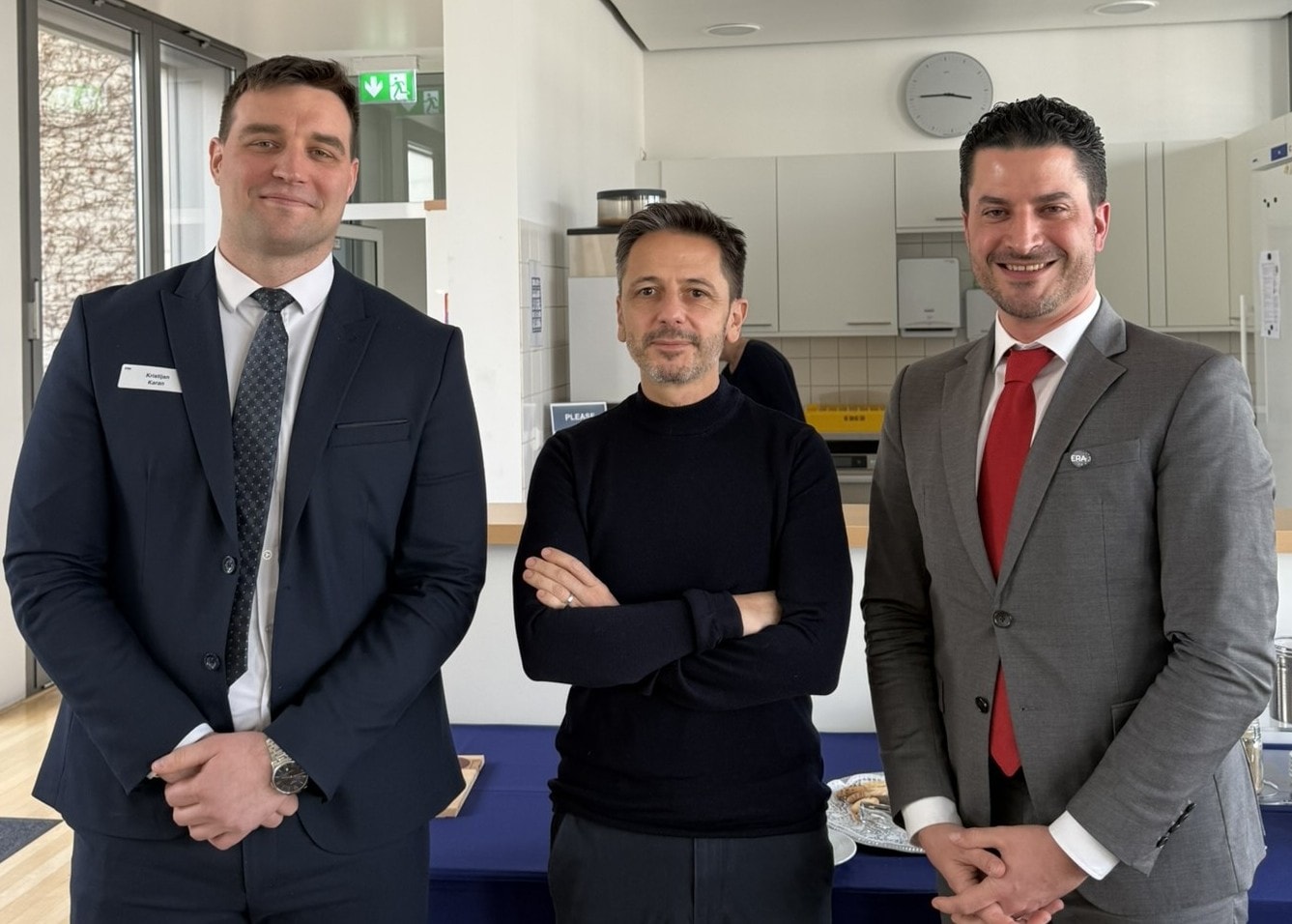
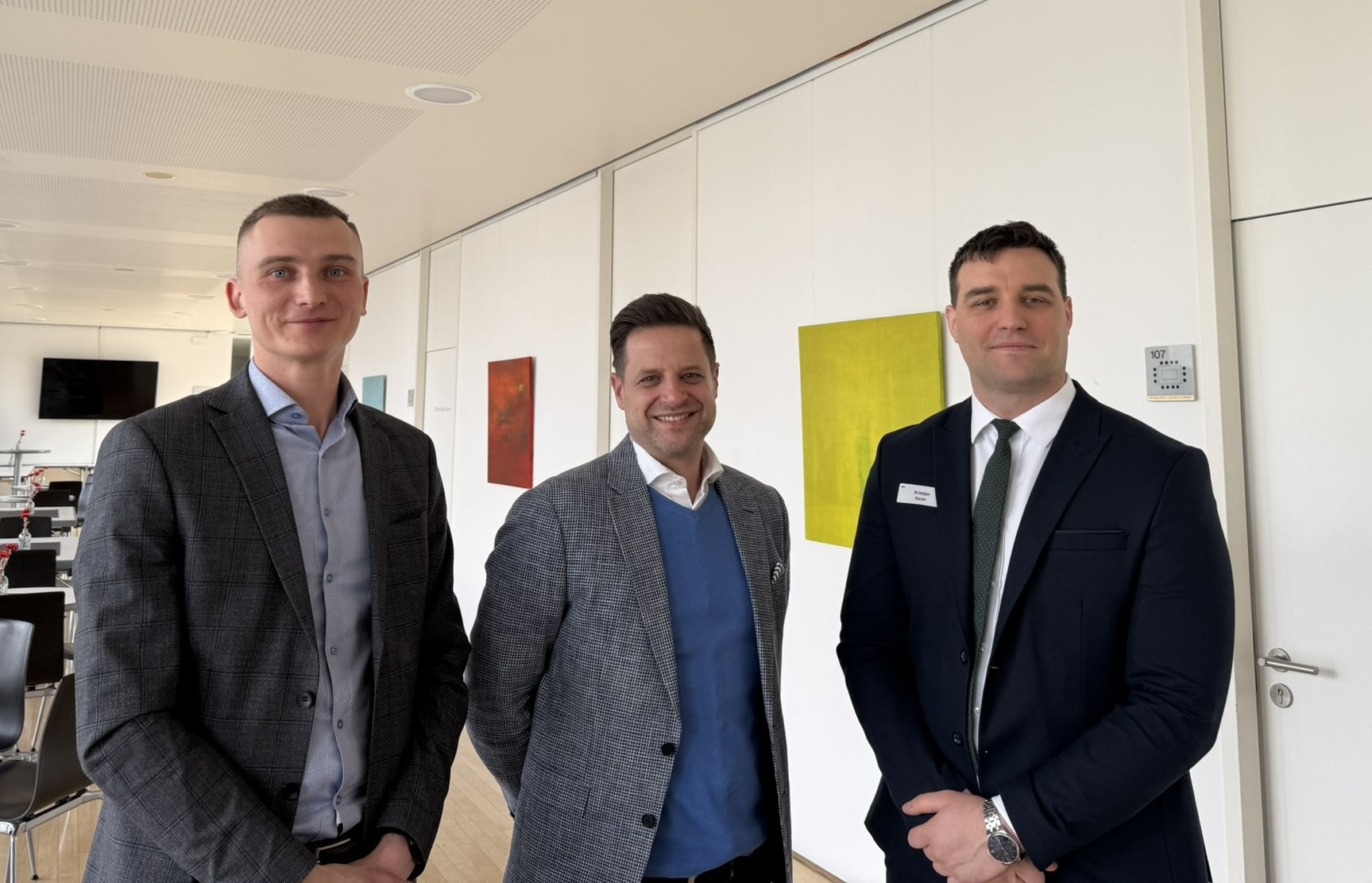
From left to right: Mr Kristijan Karan, Mr Jean-Philippe Rageade (Director of the Academy of European Law) and Mr Ramin Farinpour (Senior Lawyer at ERA).
The last time I visited Trier was in November 2024, when I took part in the Annual Conference on AML and Financial Compliance in the EU 2024. Based on both that earlier experience and my most recent visit, I consider ERA to be a true gold standard in the field of legal training. What stands out is the level of professionalism and dedication shown from the very first moment of registration, throughout the organisation of the event, and during the entire stay in Trier. ERA’s conference infrastructure was also exceptionally well designed, with a highly professional audio-visual system that ensured that questions and interventions from both in-person and online participants could be integrated into the discussion in a smooth and natural manner. Each speaking session was followed by sufficient time for questions, discussion and direct exchange with the speakers, which added significant practical value to the programme. I also greatly enjoyed the atmosphere of Trier itself, a city rightly referred to as the “Rome of the North”. I was particularly fortunate to enter the Basilica of Constantine at a moment when it was completely empty, which allowed me to fully appreciate its remarkable architecture and the sound of the organ in a truly exceptional setting.
This most recent stay in Trier further convinced me to become a member of the Friends of ERA Association, a Europe-wide network that supports ERA’s mission of strengthening dialogue, learning and cooperation in the field of EU law, while also contributing to concrete initiatives such as ERA’s scholarship programme, the Young European Lawyers Contest, and the Fund for the Western Balkans and Ukraine. For me, as a lawyer in Serbia whose practice is focused on assisting clients from EU jurisdictions in matters connected with Serbia, membership is valuable not only because it supports high-quality legal education in Europe, but also because it offers access to a professional network of like-minded legal practitioners, regular networking opportunities, national chapter activities, and high-quality conference materials and expert presentations. I also find it particularly meaningful that the Association supports legal training in candidate countries, including through its Fund for the Western Balkans and Ukraine, which reflects the broader importance of strengthening professional ties and legal knowledge in parts of Europe where closer alignment with EU legal standards remains especially significant.
Overall, this conference once again confirmed how closely developments in EU white-collar crime enforcement, asset recovery, AML, sanctions and regulatory compliance are connected with legal practice in Serbia whenever clients, assets, transactions or risks extend across borders. For our office, participation in programmes of this kind is not merely a matter of professional interest, but an important part of maintaining the level of knowledge and international perspective required to assist clients from EU jurisdictions in complex matters connected with Serbia. It is precisely through this kind of continued engagement with European legal developments and professional networks that we seek to provide legal assistance that is both practically informed and aligned with the realities of cross-border legal practice today.
Author: Kristijan Karan, Attorney-at-Law in Novi Sad, Serbia
Published on: 8. April 2026